
Aldric moved toward the far wall of the chamber. The seam was invisible to anyone who hadn’t been shown it, the same undressed stone as everything surrounding it, indistinguishable from the wall it was built into. He pressed three points in sequence without hesitation. The section of the wall released inward, making a sound like pressure equalizing.
The opening was narrow, barely wide enough for a man’s shoulders, cut straight into the rock. Beyond it was darkness and a smell that reached Edmund before the light did. Older than the chamber. Deeper. The cold of stone that had never seen the sun.
The panels set into the ceiling of the passage had been dark for a thousand years. They came on in sequence as Aldric crossed the threshold, each one catching from the one before it, light chasing itself east into the dark, revealing the passage in sections, narrow, stone-walled, running east beneath the desert floor and disappearing into the distance.
Edmund stood at the threshold for a moment. Then he stepped through.
The passage sloped gently downward before leveling, then began its long eastward run beneath the estate, beneath the city above it, beneath eighty kilometers of desert toward the volcano already pulling at his chest.
Thirty meters in, hovering above a magnetic rail embedded in the passage floor, was the transport. A single enclosed capsule built for two. It was low, dark, elongated, holding perfectly still above the rail. It had been sitting here since before the sleep. The composite surface was exactly as Edmund remembered it. It had no corrosion or settling. The engineering held.
The hatch was set into the top. Aldric found the release without looking for it, two points pressed in sequence, and the hatch opened upward with a short percussive release, pressure equalizing in both directions at once. He went down the ladder rungs and disappeared into the interior.
Edmund followed. The rungs were cold and exactly spaced. He descended four steps and felt the hatch seal above him before he reached the bottom, a pressure change in his ears, the outside world closing off. The interior was close and dim, the ceiling thirty centimeters above his head when he sat. Two seats facing forward. A single instrument panel running the width of the capsule, dark until Aldric’s hands moved across it and the screens came alive one by one.
No windows. The only world available was what the console showed.
The transport rose, a barely perceptible shift as the magnetic rail engaged, and moved east without sound. Edmund felt it only as a change in the quality of stillness. One kind of motionless becoming another.
Aldric was already working.
From the console he pulled a handheld display, a flat rectangular screen, palm-sized, slotting into a recessed mount between their seats, and brought up the live feeds from Morrow’s monitoring arrays, thermal satellites, electromagnetic readings, atmospheric pressure at the site. The strike rate at time of transmission was 11,000 per minute. The current rate was on the screen before Edmund had fully settled into his seat.
14,847 lightning strikes per minute and still climbing.
Edmund looked at the number. Said nothing.
Aldric’s hands moved across the console. A transmission went out to all six factions simultaneously. Short enough that Edmund almost missed it. Carrington authentication confirmed. Brothers en route to emergence site. Stand by for updated field intelligence. Maintain current positions. He transmitted without looking up from the console.
The responses came back staggered. The House of Azazel first, immediate, a secondary notation from their senior chamber operator flagged urgent, asking for Carrington interpretation of the ritual silence. What did it mean that the flame found nothing. The House of Azazel had never encountered this and needed guidance.
Aldric read it. He didn’t respond.
The Seventh Seal responded next, their celestial monitoring array had detected a secondary atmospheric anomaly developing forty kilometers south of the primary site. Minor. Possibly related. Flagged for awareness.
The Calibrators confirmed position. Clinical, brief, exactly what was expected.
The Covenant of the Written Word confirmed position. Their communication infrastructure was fully operational. Neural broadcast networks standing by.
The Bloodline of Cain confirmed. Cain himself was already positioned.
The Children of the Cauldron’s response arrived last. Edmund noticed the delay, not long enough to be a technical issue, long enough to mean a decision required prolonged deliberation before transmission. Their confirmation was standard. Attached was a secondary notation, timestamped 01:58.
It read: After the initial transmission, the Cauldron’s senior operators made the decision to perform the Rite of the Sovereign Descent, a ritual of last resort, never before performed in the history of the Cauldron. The protocols for its execution have existed for centuries. The authorization to perform it has never been given until now.
It produced results.
The signal from the emergence site is fragmented but coherent. It is not singular. Two distinct presences are emanating from the same location, equal in magnitude, separate in origin. Not one signal split into two. Two signals are occupying the same point.
The cost of its performance is as follows. The three conduits who received the signal through the Sovereign Descent are alive. They are no longer what they were. The organized recursive structure the signal carried, patterns repeating inside patterns, has written itself into their neural tissue. Their brains are processing something that does not stop. They are attempting to transcribe what they experience. The output is in a language the Cauldron cannot identify. It matches no known linguistic structure in the archive. It matches the electromagnetic pattern the field asset’s neural-link detected at the site before shutdown. The conduits have been isolated. The Cauldron does not know if this will resolve. The Cauldron does not know what was written into them. The Cauldron is including this now because the brothers should know that whatever is at the Eye of Sheol is not only transmitting outward. It is writing itself into anyone who receives it directly.
Edmund read it twice. Aldric had moved on to the thermal feed.
“You expected a different location,” Edmund said.
Aldric didn’t look up from the console. The strike rate climbed to 15,200.
The transport moved east through the dark.
Edmund watched the number climb. The sensation in his chest was stronger now than when they boarded.
They rode in silence. The passage was absolute dark beyond the capsule. No reference points. No sense of speed except the accumulating kilometers on the console display.
20km. 40km. 60km.
Above: desert floor and open sky. Behind: the estate, the archive, everything they built. Ahead: the storm raging above the Eye of Sheol. Two signals. One location. Neither matching anything in the archive.
At some point in the final kilometers Aldric pulled the display from its mount and held it toward Edmund without comment.
Edmund had been reading the data for forty minutes, numbers, readouts, strike rates, thermal signatures. Now he saw it as an image for the first time.
The storm above the mountain filled the screen.
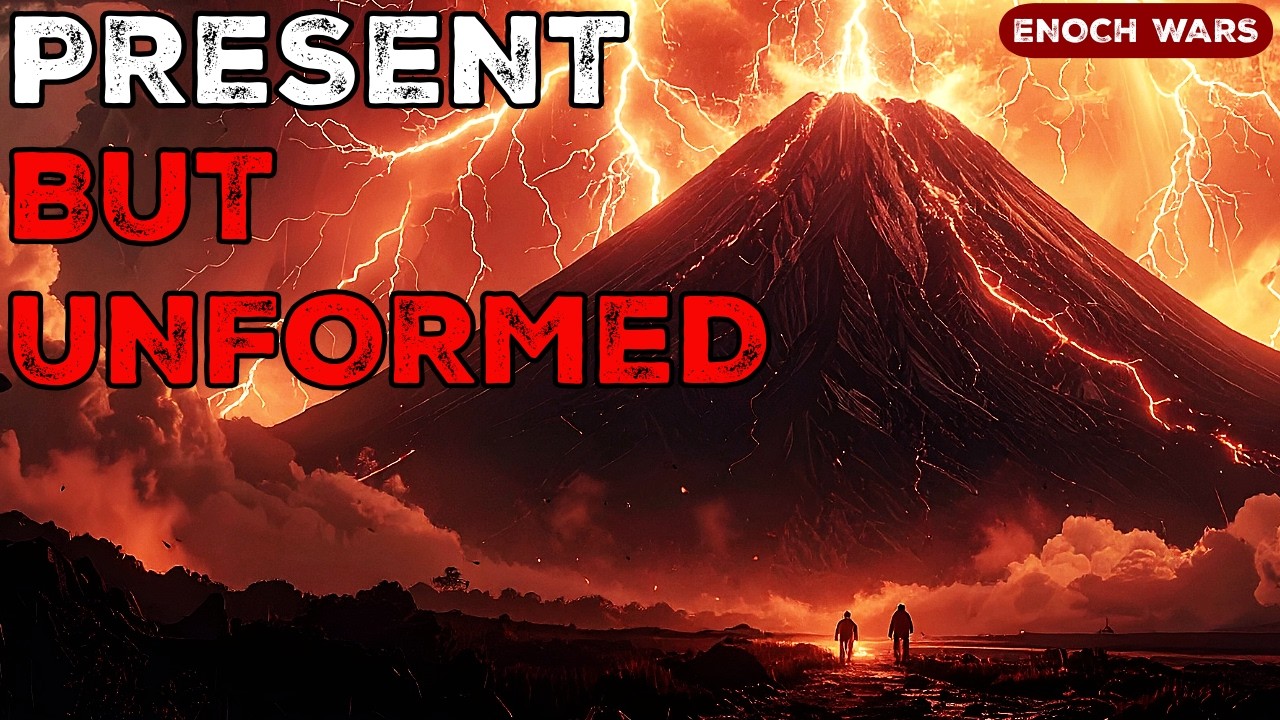
It was rotating. A gradual spiral of a pressure system finding its equilibrium on a deliberate center rotation. On the thermal feed the top of the volcano glowed white with heat. The lightning storm rotated above it, and the still center eye of that rotation was locked directly above the light pulses surging up from below. It had not moved in the forty minutes since Morrow’s first transmission. Natural storms move. This one didn’t.
The lightning was the part Edmund kept returning to. The Morrow report said ascending, charge rising from the ground rather than descending from the sky, but the thermal feed showed a curious pattern the report hadn’t captured. The strikes were not random. They were moving in sequence around the perimeter of the storm, rotating with it, each strike displaced from the last by an interval Edmund’s mind kept trying to calculate and kept arriving at the same number. He looked at it for a long moment.
He didn’t say the number aloud.
The thermal glow from the vent pulsed beneath it all, painting the underside of the clouds in copper and red. The pulse had a rhythm. Edmund had felt that rhythm in his chest since before he opened his eyes.
“The interval between strikes,” Edmund said.
Aldric said nothing.
“It’s consistent,” Edmund said.
The strike rate on the console reached 16,000.
Aldric closed the screen.
The passage began to rise.
Gradually at first, then more steeply, the floor angled upward through volcanic rock that grew warmer as they ascended.
Edmund felt the change before the temperature display confirmed it.
The transport stopped. The tunnel ended.
Aldric released the hatch. The air that came down through the opening was the same recycled tunnel air, sealed, controlled, exactly as engineered. Edmund climbed out after his brother.
They were still inside the mountain. The tunnel widened here into a small chamber cut from the volcanic rock, just enough space for two men to stand. The walls were warm to the touch. The ceiling was low. At the far end, set directly into the rock, was a door. Not the same engineered precision as the chamber wall or the transport hatch, it was older and heavier. Aldric pressed the release sequence. Edmund heard the seals disengage one by one, four of them. The door swung inward.
The air hit Edmund before anything else did. Sulfur first, dense enough to taste rather than smell. Then heat rising from the ground, from the rock itself, the mountain running warm from its own interior. And underneath both of those something older, the kind of smell that had no category because nothing on the surface of the earth produces it.
Edmund stood at the threshold. A thousand years of what men had built behind him. Ahead: everything they hadn’t.
He stepped through.
They were standing at the base of the mountain in open air for the first time since the descent. Pre-dawn dark. No city lights at this distance. The desert floor around them was flat and still.
Above them was not.
The mountain rose in the dark, not a shape so much as an absence of stars, a mass that blocked out everything above them on three sides and continued upward past what Edmund could resolve in the dark. The rock face above was not sheer. It rose in irregular stages, broken and ancient, volcanic rock that cooled in layers across however many thousands of years the mountain was building itself. Somewhere above that, invisible from here, was the top. And from the top came the light.
Not the orange of fire. Not the red of lava. Edmund’s mind reached for both and found neither sufficient, whatever was rising from above sat between those categories and refused them, a light that painted the underside of the storm in copper and a deeper shade of red, a color that made the clouds look less like weather and more like a vast deliberate ceiling.
The storm wrapped the mountain completely. Lightning moved through it in patterns too regular for nature, not the random branching of a storm system but a rhythm. Edmund felt in his sternum before he heard it. The thunder did not arrive in separate strikes. It was continuous, a low pressure that lived in the chest rather than the ears, and was building for longer than it existed.
Aldric stood beside him for one full second. Head tilted back. Reading it.
Then he moved toward the slope.
Edmund stayed where he was. The rock under his boots was uneven and porous, still holding the day’s heat on its surface. Ash in the air, fine enough that he only knew it was there when he breathed. The light from above moved across the backs of his hands in slow pulses, the mountain breathing, or something above it was, Edmund could not locate the distinction.
He was no longer tracking the sensation in his chest. Whatever lived inside the lightning above him had been producing it since before he opened his eyes. It was not pulling at him now. It was simply there. Waiting.
The storm pulsed once, a single surge of light through the clouds, brighter than the intervals before it. In the half-second of that light, Edmund saw, at the base of the rock face three meters to his left, a long crack in the volcanic stone he didn’t notice, narrow, running vertically, with something growing in it. A plant. Small, pale, rooted in the crack of a mountain that should have been too hot and too hostile for anything to grow. It was there and then the light was gone and he could not find it in the dark.
Edmund felt the pulse move through him at the same moment.
He stood very still.
Above them, the storm turned. Edmund stood where it found him and did not follow Aldric immediately. The thing in his chest was still moving at the storm’s rhythm. Present. Familiar. The same frequency he had carried into the sedation chamber and felt still waiting when he opened his eyes.
Then, he followed his brother up the slope toward whatever was waiting at the top.