
The Book I Keep Finding Reasons Not to Read.
It’s been sitting there. You know the kind of book I mean, the one on the list, the one that people reference in hushed tones, the one that certain readers carry like a badge. The Brothers Karamazov. Eight hundred and some pages. Published in 1880. Russian. Dense.
I haven’t read it.
I want to get that out in the open immediately, because I’m not going to write the kind of editorial where someone who has read a thing tells you why you should read it too. I’m writing the other kind, the kind where someone who hasn’t read it yet explains why he’s finally, after years of reasonable avoidance, going to sit down and do the thing.
This is me talking myself into it. In public. You’re welcome to follow.
Is The Brothers Karamazov Hard to Read?
Yes and no. The prose itself is more accessible than the reputation suggests, Dostoevsky was writing serialized fiction for a general audience, not an academic one. The sentences don’t fight you.
What fights you is everything else. It is enormous. The Russian names are a genuine obstacle, every character has three of them and the text uses all three interchangeably. The pacing is nineteenth century, not modern thriller. The philosophical digressions are long and they are serious and they demand your attention.
But here is what I’ve come to understand about intimidating books. The intimidation is information. When something that large has survived that long, when it has continued to be pressed into the hands of people across every century since it was written, when everyone from Freud to Camus to Jordan Peterson has been forced to reckon with it, that isn’t hype. That’s a signal.
The real question isn’t whether it’s hard. The real question is whether it’s hard in a way that pays off. I am becoming convinced that this one is.
Brothers Karamazov Summary: What Is This Book Actually About?
Here is the part that changed my attitude toward this book. I started learning what it actually contains, instead of what its reputation says.
What I found was this: Fyodor Dostoevsky himself. A man who had survived a mock execution, who had served four years of hard labor in Siberia, who had buried a child, who had wrestled with faith and gambling addiction and debt and the death of God and the rise of nihilism, and who poured all of it, every last gram, into one final novel that he completed four months before he died.
That is a man emptying himself onto the page.
The result isn’t a philosophical treatise dressed up as fiction. It is a murder mystery. It is three brothers who cannot stand each other, Dmitri (passion), Ivan (intellect), Alyosha (faith), all in love with the same woman, fighting over an inheritance, while their disgusting father drinks himself stupid and gets himself killed. It is courtroom drama. It is a dying child and the boys who loved him standing in a circle in the snow. It is a monk who radiates a love so complete it disturbs everyone around him. It is two brothers in a tavern at two in the afternoon, talking themselves to the edge of the universe.
And inside all of that is one chapter, one prose poem, that contains what may be the most devastating argument against God, against religion, against the very concept of human freedom, ever committed to paper. Written by a man who believed in God with everything he had.
That chapter is called The Grand Inquisitor. And it’s the reason I stopped making excuses.
The Grand Inquisitor: Dostoevsky’s Most Dangerous Chapter
There is a character named Ivan. He is 24 years old, brilliant, cold, and he does not reject God so much as he returns the ticket. He cannot accept a world in which the suffering of a single innocent child is the price of any cosmic harmony, however beautiful. He has read the accounts. He can cite them.
Then Ivan tells his brother a story he made up, titled Seville. It’s about the Spanish Inquisition. Christ has returned, performed miracles, raised the dead in the Cathedral square. The Grand Inquisitor, ninety years old, a Cardinal, has him arrested.
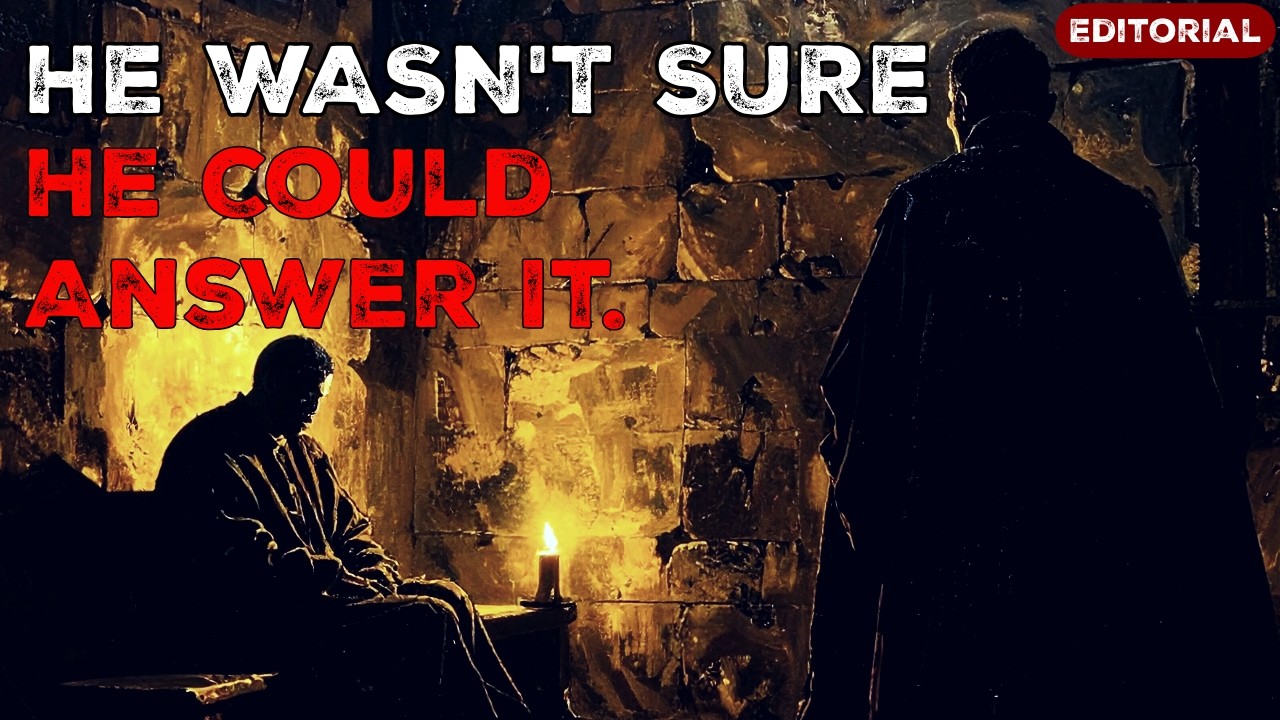
There is a scene in Book V where the Inquisitor comes to Christ’s cell alone, at night, and delivers a monologue. He makes the case that Christ’s gift of human freedom was a catastrophic mistake, that most people cannot bear it, do not want it, will trade it gladly for bread and certainty and someone to tell them what to do. He builds that case on Satan’s three temptations in the desert, the three offers Christ refused. And he explains what the Church did with those offers instead.
I sat with that for a long time. Because Dostoevsky, a man of ferocious Christian faith, gave that argument everything he had. He built the strongest possible case for the other side. And then he answered it without a counter-argument, but with the whole of Alyosha’s life. With a theology of radical love.
This is why The Grand Inquisitor remains one of the most cited passages in all of existentialist philosophy, political theory, and theology. Camus, the French existentialist, built his entire theory of rebellion around Ivan’s argument.” Political philosophers still use it to diagnose soft authoritarianism, systems that control through comfort rather than cruelty. Atheists cite it as the sharpest case against faith ever written. Believers cite it as the deepest faith ever tested.
Dostoevsky wrote to his editor that it was the most powerful denial of God he had ever encountered in literature, and that the rest of the novel was his answer. He wasn’t sure his answer was strong enough.
I want to find out for myself.
Why a Christian Should Read the Devil’s Best Argument
There is a passage in Ephesians 6 that the Church has largely domesticated into a metaphor. Put on the full armor of God. We turn it into a children’s Sunday school poster, a cartoon knight with a plastic sword. What Paul was actually writing was a combat manual. Know your enemy. Know his devices. Understand the nature of the war before you walk into it.
Dostoevsky understood this. He understood it so completely that he did something most Christians would consider reckless, he wrote the devil’s best argument himself. The case against God that actually lands, that has actual weight, that has been repeated by serious philosophers and serious atheists for over a century because they cannot improve on it.
And then Dostoevsky wrote the novel as the answer to Satan’s perfect argument.
That is the move I want the Body of Christ to be capable of making. I don’t want the retreat into safe theological language, or the refusal to engage because the question is uncomfortable. The willingness to sit inside the strongest possible version of the opposing argument, to understand it, to feel its force, to articulate it better than the person who holds it, and then to have the answer.
Dostoevsky doesn’t try to out-argue Ivan. He doesn’t meet the intellectual case with a better intellectual case. The answer comes from a different direction entirely.
The Gospels and Dostoevsky defeat the Devil’s best argument with a counter intuitive answer.
The answer is a life. It is Alyosha.
It is kenotic love. The love that drove God to empty himself of glory and take on flesh, to enter the suffering rather than explain it from outside it. Not love as sentiment or abstract goodwill toward humanity. The kind that costs everything and expects nothing. Enacted in the world quietly, persistently, toward actual people. That is what Alyosha does. And that, Dostoevsky is saying, is the only answer Ivan’s argument cannot touch, because it doesn’t argue back. It just shows up
But you cannot get to that answer without first going through the argument. This is where Christian engagement with culture so often fails. We want the answer without the question. We want to skip Ivan’s tavern speech and go straight to Alyosha at the stone. Dostoevsky knew you cannot do that. The answer only means something if you have genuinely sat with what it is answering.
This is what Ephesians 6 is actually about. The whole armor of God is not defensive equipment for people who intend to hide. It is battle dress. The belt of truth, the breastplate of righteousness, the shield of faith, these are for a soldier who intends to know the terrain, understand the enemy’s position, and engage. You cannot stand against the schemes of the devil if you do not know what the schemes are. You cannot have an answer if you have never seriously held the question.
The Brothers Karamazov is one of the most serious engagements with that question that literature has ever produced. Written by a man who had been through everything life could throw at a person, the execution platform, the death of a child, the edge of his own faith, and who came back with something he needed to say. Because the answer to Ivan’s argument is not a proposition. It is a person.
I want to be able to do what Dostoevsky did. I want to be the kind of Christian who can hold Ivan’s argument in one hand and Alyosha’s life in the other, and say, here is the question at its strongest, and here is what answers it. Not because I have all the answers. Because I have taken the question seriously enough to deserve the conversation.
That is what Apokalypsis is for. And that is why I’m reading this book.
Why Now
Apokalypsis exists because I believe the darkest questions deserve the most serious engagement without sanitization or safe language that produces a comfortable experience. Apokalypsis doesn’t create the kind of theological fiction that decorates any worldview without ever testing it. The kind that goes to the limits of what belief can survive, and comes back with something true.
The Brothers Karamazov goes to the edge. It has been going there for 145 years. Nothing has gone further. If I am going to write seriously about the places where God and darkness share a border, the Watchers, the fallen, the war behind the visible world, then I need to have sat inside the best fictional articulation of the question those subjects are actually answering.
This is the book that asks the question every dark story is secretly answering. I need to have read it.
Brothers Karamazov Themes: What the Novel Is Really Asking
For anyone coming to this book without background, here are the five questions the novel turns on.
Can God be trusted in a world that permits the suffering of children?
This is Ivan’s question. The novel’s entire architecture, every character, every plot turn, is an attempt to answer it without flinching from it.
Can human beings actually bear freedom?
The Grand Inquisitor says no. The novel asks whether he’s right. This is the question that has made the book indispensable to every political philosopher, existentialist, and theologian who has touched it.
Who is actually guilty for a murder?
Dostoevsky’s answer is not who you expect. And his deeper suggestion is that guilt is not individual, it is distributed. Every soul is responsible for every other soul.
What is the difference between abstract love and actual love?
Alyosha’s teacher, Father Zosima’s central teaching is that love is not real until it meets a specific person, including the one doing wrong right in front of you. You can weep for suffering humanity in the abstract and despise every human being you actually encounter. Zosima calls that a lie. Active love of actual persons in front of you, especially the difficult ones, is the only kind of love that holds.
Is faith an argument or a life?
Alyosha does not argue for God. He lives in a certain way. That is the distinction Dostoevsky is making, and it is the one that either satisfies you or it doesn’t.
How Long Does It Take to Read The Brothers Karamazov?
At 15–20 minutes per day, a realistic daily reading commitment, you finish in 12 to 14 weeks. That is the pace I’m planning. Slow enough to absorb it. Consistent enough to maintain momentum.
But there is something I’ve noticed about difficult books, which is that the difficulty is not neutral. It is shaped. The difficulty of The Brothers Karamazov is the difficulty of the questions it asks. You are not struggling against the prose, you are struggling alongside the characters with the same things they are struggling with.
Whether God can be trusted. Whether love is enough. Whether a man who does everything wrong can still be forgiven. Whether freedom is a gift or a catastrophe.
These are not small questions. They deserve a book this size.
I built a free week-by-week reading schedule for exactly this pace, with discussion questions and themes for each section.
[Download the study guide here]
Get the Book
Free: Constance Garnett translation (public domain)
- FREE Read Online / PDF: archive.org – The Brothers Karamazov (Garnett, Modern Library)
The Garnett is smooth and completely readable, it’s been the standard English translation for over a century for good reason. Scholars note that she occasionally smooths over Dostoevsky’s deliberately rough edges, but for a first read, you won’t miss anything that matters. The Katz (2023) is the most recent major translation and strikes the best balance between accuracy and readability if you want a physical copy.
Best current translation
Michael R. Katz (Liveright, 2023)
- Hardcover: amazon.com
- Paperback: amazon.com
- Kindle: amazon.com
The Brothers Karamazov Study Guide – Free Download
Once you have the book use this reading guide to pace yourself through it.