
If you’ve ever stared up at the night sky and had the sudden, irrational certainty that you weren’t looking up, that there was no up, that you were looking out into something that had no floor and no ceiling and no interest in the fact that you were there, you already understand what cosmic horror is trying to do.
It’s not about jump scares, slashers, or haunted houses. Cosmic horror is the genre built around a single, suffocating idea, you are small, the universe is vast, and it does not care about you at all.
That idea has produced some of the most unsettling fiction ever written. And it’s been doing it for nearly a hundred years, long before anyone called it “cosmic horror.”
So What Exactly Is a Cosmic Horror Short Story?
A cosmic horror short story is a work of dark fiction in which the central terror comes not from a villain or monster, but from the nature of the universe itself. The horror is existential, it emerges when a character (and by extension, the reader) is forced to confront forces so vast, so alien, and so indifferent that human life feels meaningless by comparison.
Think less Dracula, more the void between galaxies looking back at you.
The genre is also called Lovecraftian fiction, after H.P. Lovecraft, the American pulp writer who popularized it in the 1920s and 30s. Lovecraft himself used the term “weird fiction” and the term “cosmic horror” came later, as a label that critics and readers used to name what he’d built. Whatever you call it, the hallmarks are consistent, dread over gore, atmosphere over action, and an ending that leaves you feeling smaller than when you started.
The DNA of a Lovecraftian Short Story
Whether you’re reading a century-old Lovecraft original or a modern cosmic horror short story published last week, you’ll find the same core ingredients showing up again and again.
Cosmic horror runs on the following five ingredients.
The unknowable entity. The monster in a cosmic horror story isn’t evil the way a human villain is evil. It simply is, operating on a scale so far beyond human comprehension that concepts like good and evil don’t apply to it. It doesn’t hate you. It doesn’t even notice you. That’s what makes it terrifying.
The protagonist who knows too much. Cosmic horror stories often follow researchers, scholars, or obsessive investigators who stumble onto something they were never meant to find. The discovery doesn’t save them. It breaks them. Knowledge in this genre is almost always a curse.
The unreliable narrator. By the time a character in a Lovecraftian short story is telling their story, they’re usually already damaged by what they’ve seen. The narrative itself becomes unstable, and the reader is never quite sure how much to trust.
The atmosphere of encroaching dread. Cosmic horror doesn’t build toward a jump scare. It builds toward a slow, creeping realization. Something is wrong. Something has always been wrong. And now you can’t unknow it.
The pyrrhic ending. Even when a character “survives,” they don’t really escape. The best cosmic horror short stories end with the protagonist (and the reader) fundamentally changed, and not for the better.
Those five ingredients have stayed remarkably consistent across a century of cosmic horror fiction, but the philosophical assumption underneath all of them is something most writers in the genre have never examined.
Lovecraftian Fiction and the Problem It Created.
Here’s where it gets interesting, and where Apokalypsis enters the conversation.
Lovecraft was genuinely brilliant at atmosphere. He understood something real about fear, that what we can’t see or comprehend is more terrifying than what we can. His best work, “The Colour Out of Space,” “The Shadow Over Innsmouth,” “At the Mountains of Madness,” still holds up as masterclass-level atmospheric horror.
But Lovecraft built his entire fictional universe on a philosophical foundation that goes largely unexamined in most cosmic horror fiction, cosmicism. The belief that the universe is fundamentally indifferent. That humanity has no special significance. That there is no meaning, no divine structure, no purpose, only vast, cold, mindless forces grinding forward in the dark.
For Lovecraft, the horror was a universe that operated entirely without reference to human beings, vast, ancient, and complete without us. He didn’t think life was meaningless in the small sense. He thought the cosmos was simply finished before we arrived and would be finished long after we were gone. The terror wasn’t that nothing mattered. It was that nothing out there was watching.
The terror was a universe with no God in it.
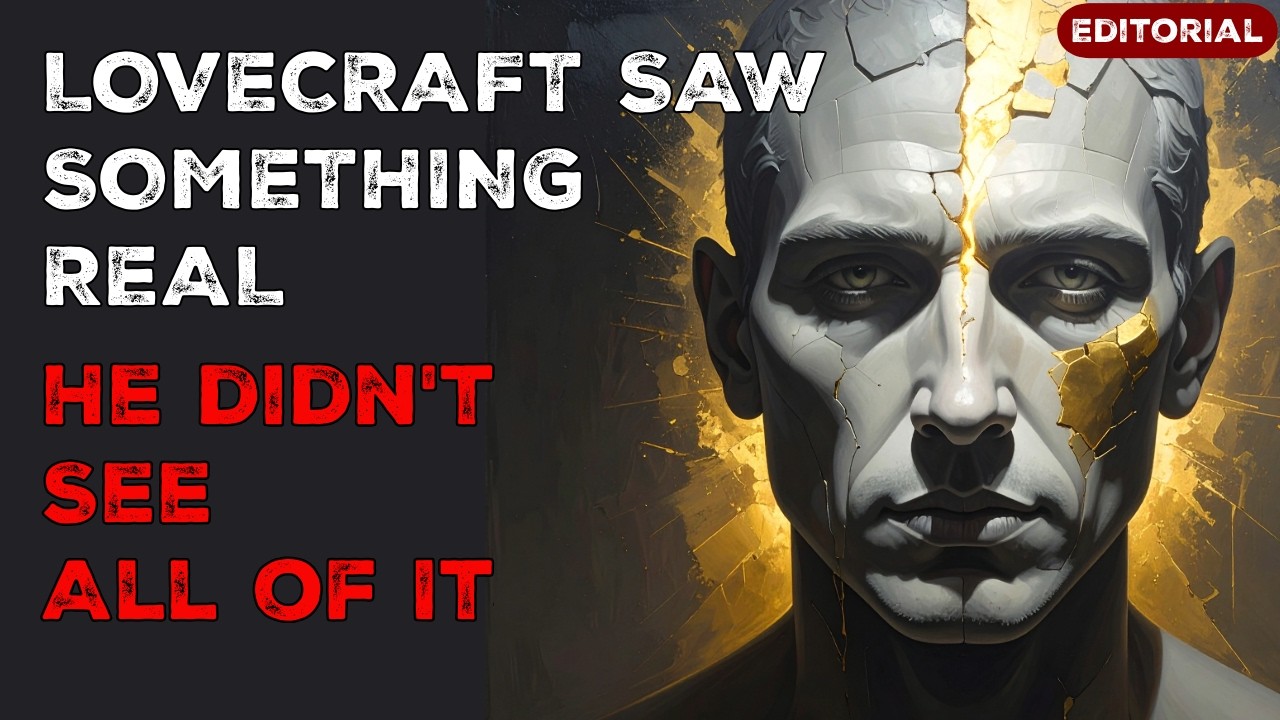
Here’s the thing, what if he was only half right?
What if the universe really is that vast and that terrifying, but it’s not meaningless? What if the cosmic scale isn’t evidence of our insignificance, but of something almost unbearably significant happening just beyond our field of vision ?
That’s the question that drives the fiction at Apokalypsis Magazine. We write in the tradition of weird fiction and cosmic horror, the dread, the unknowable, the sense that reality has a hidden architecture most people will never perceive. But we don’t accept Lovecraft’s conclusion. We think he got the genre right and the universe wrong.
The horror is real. The indifference isn’t.
The oldest wisdom literature in the world saw this coming. The fear of the Lord is the beginning of wisdom, not the end or destruction of it. The proverb doesn’t tell you the vastness isn’t real. It tells you the vastness has a source, and that standing before it undone is where knowledge actually starts. Lovecraft felt that terror and concluded nothing was there. The biblical writers felt the same terror and concluded the opposite. Apokalypsis lives in that gap.
Where Cosmic Horror Is Going (And Where It’s Already Been)
Cosmic horror has never been healthier as a genre, and it’s evolved significantly since Lovecraft’s era. Modern writers like Caitlín R. Kiernan have pushed the weird fiction tradition into new territory, while others like Victor LaValle and N.K. Jemisin have engaged with Lovecraft’s legacy critically, asking harder questions about who the genre was built for and who it left out.
Sci-fi horror short stories have expanded the cosmic horror tradition into deep space and near-future settings, where the “unknowable entity” might be an alien intelligence, a physics-breaking phenomenon, or a technology that makes human consciousness feel suddenly fragile. The genre has also cross-pollinated with weird fiction, surrealism, and theological fiction to produce some of the most adventurous dark speculative fiction being written today.
What remains constant across all of it is the core emotional experience, that vertiginous feeling of standing at the edge of something your mind was never built to process.
That feeling is worth chasing. It’s worth writing toward. It’s worth reading for.
Read Dark Speculative Fiction at Apokalypsis
If you’re looking for cosmic horror short stories that don’t leave you with Lovecraft’s cold, empty universe, you’re in the right place.
Apokalypsis Magazine publishes dark speculative fiction, weird fiction, and theological horror for readers who want their darkness to mean something.
Browse the full story catalog →
Apokalypsis Magazine, Dark speculative fiction for readers who aren’t afraid of the dark. Or the light.