
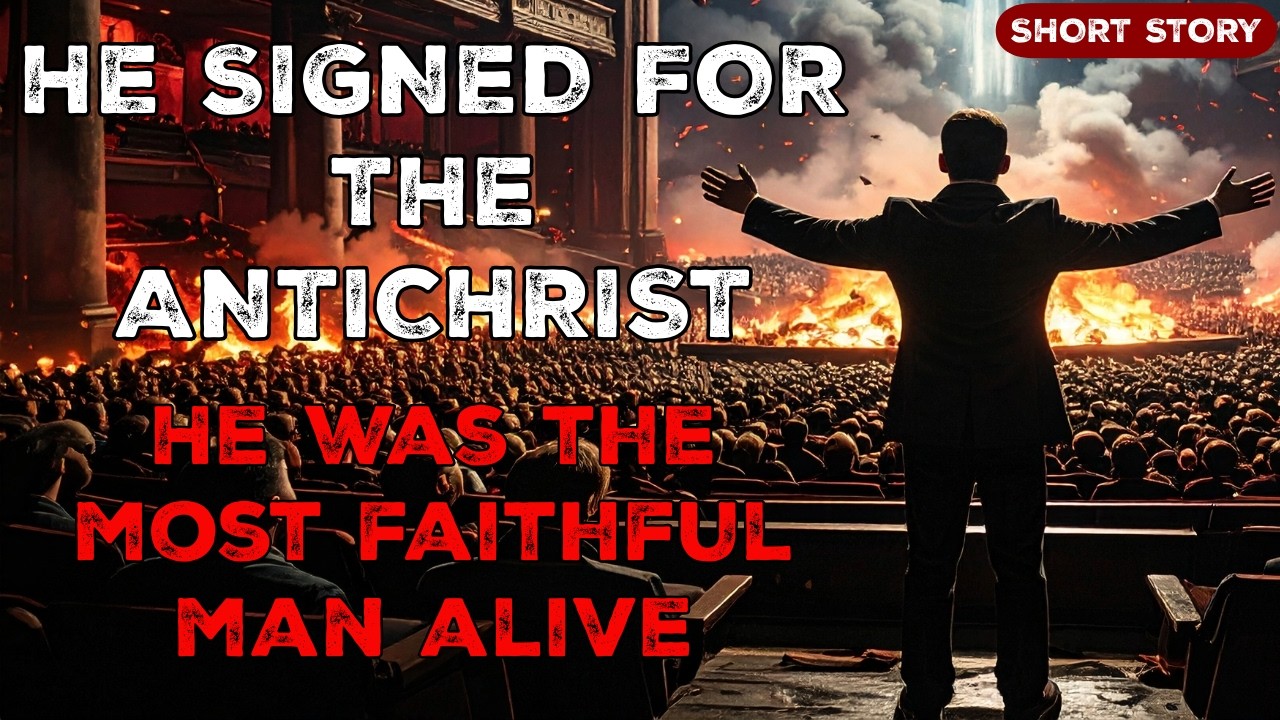
The Flame
Edmund Carrington stood at the window of the tower room, his hands at his sides, and watched New Geneva burn in celebration. Seven years of Tribulation, war, famine, plague, the sky doing things skies were not supposed to do, and now this.
The Global Covenant’s Unity Festivals had been running six days straight, the largest coordinated celebration in human history, or what remained of it. The streets below choked with bodies and firelight, drums and smoke, the raw noise of a world that had decided by sheer collective force of will that it was done suffering. The Unity Hymn cycled from every speaker tower, patient and warm, the sound of a world deciding in unison that what they had survived was worth celebrating and that the thing that saved them deserved their love. Some of them even believed it was the beginning of peace. Some of them were right, in the way that a man stepping into a trap is right about the floor being solid.
The glass was cold against his forehead. He had been standing long enough that he had stopped noticing.
Behind him, his brother was talking.
“Thirteen generations,” Aldric said. He was moving around the conference table, touching things, the backs of chairs, the edges of documents, the surface of objects he owned. Aldric had always touched what he owned. “Thirteen generations of Carringtons keeping the flame alive, and it comes to this room. Tonight. Us.”
Edmund said nothing. He was good at nothing. He had perfected it over thirty-four years of living inside his brother’s orbit, the particular silence of a man who is present without being visible, who hears everything, who is trusted precisely because he appears to want nothing.
“You’re not excited,” Aldric said.
“I’m focused,” Edmund said.
Aldric laughed. It was a warm laugh, a real one; Edmund had never doubted that his brother was capable of genuine warmth. That was the thing about Aldric that nobody outside the family understood. He was not a cold man. He loved deeply, in his way. He loved his bloodline, his mission, the long chain of Carrington purpose stretching back through centuries of careful preservation. He loved Edmund, probably more than he loved anyone.
That was what made it complicated.
Edmund had spent twenty years being exactly what the Carrington name required: studious, precise, useful. He had seen things most men would spend their entire lives disbelieving. He had touched the evidence with his own hands. Belief wasn’t a choice; it was the only honest response to what the Carrington name had shown him. He had believed, in his way, in the mission. Then the Tribulation came, and belief turned out to be a different thing than he had understood it to be.
“The documents are ready,” Aldric said. “Morrow’s people have confirmed the terms. After tonight, the Carrington archive goes into the vault, encoded, dormant, protected for however long the Kingdom lasts.” He paused. “A thousand years, if the prophecy holds.”
“And if it holds,” Edmund said, “our descendants wake up into a world that’s forgotten everything. And they rebuild.”
“They rebuild,” Aldric confirmed. “From the inside. The way we always have.”
Edmund turned from the window. His brother was standing at the head of the table now, the documents spread before him, his face lit by the glow of the celebration below. He looked, Edmund thought, like a man at the absolute center of his own story. Like a man who had never once questioned whether the story was true.
“I’ll be ready,” Edmund said.
The Theft
Morrow’s people arrived at the estate at half past eleven. Edmund heard them in the entrance hall before he saw them, footsteps moving through the corridor below, then ascending. He watched them come through the door of the tower room beneath the charter words carved into the lintel above it. The same words appeared on every government building in every Covenant city, in every language still spoken on earth: Love God, love yourself, love your neighbor, this is the whole of the law, and everything else is derived from it.
None of them bore the Mark. The Carringtons didn’t either. There was a category above the system, and everyone in this room tonight was in it. Edmund had spent a long time deciding how he felt about that. The Unity Hymn drifted from a speaker somewhere below, the sound of a world that had decided to call its arrangements love.
The Global Covenant had risen from the ruins of the Tribulation’s fourth year, when enough of the world’s surviving power structures had decided that resistance to unified governance was extinction. Its founders called it the great act of love, the dissolution of borders, the end of sectarian conflict, the beginning of a humanity that finally, after all its centuries of war and division, chose to love its neighbor as itself.
They were not wrong about the words. That was the point. Those were the words of Christ himself, lifted whole from scripture and pressed into marble and broadcast from every tower in New Geneva. The Covenant had not invented them. It had taken them, the real thing, the source, words that had meant something specific and costly when they were first spoken, and made them into a motto. Into branding. Into the verbal architecture of a system that produced the opposite of what those words required.
Edmund had read those words a thousand times. He believed them completely. That was the sharpest edge of living inside the Covenant’s world, not that it was built on lies, but that it was built on a truth so precisely borrowed that most people could not feel the difference between the original and the copy. The Covenant’s love was real in the way that a photograph of fire is real. It had the shape. It had the color. It produced no heat.
What it produced instead was compliance. Warmth administered at scale. A love that asked you to surrender the specific, particular thing you were, your own loyalties, your own seeing, the irreducible texture of who you were, into something collective and warm, and to call that surrender devotion. The Covenant had taken Christ’s own words and called the administered warmth what those words had always meant. It was the most elegant theft in human history. The words were true. The Covenant was not.
People who refused to dissolve, who insisted on remaining specific, on loving in ways the system couldn’t measure or replicate, were quietly reclassified. Frequency deviation, the Covenant called it. The reclassification had teeth.
Edmund knew three people who had been reclassified. None of them were visible anymore.
The Frequency
The archive vault was three levels below the estate, accessible through a passage that looked like a wall and had looked like a wall for eleven years, the first of many such disguises in the complex that lay beneath the Carrington grounds. Edmund had been inside it many times. He knew what it held: seven centuries of occult theology, bloodline records, encoded prophecy, the technical architecture of the long dormancy plan. Everything the Carrington line had gathered and protected through plague, war, the Tribulation itself.
He also knew what Aldric didn’t know was in there.
Two years ago, Edmund had begun adding to the archive. Not removing, Aldric would have noticed any absence. Adding. Small things. A folded page tucked inside a manuscript. A second encoding was layered beneath the first in a document Aldric considered complete. Nothing that announced itself. Nothing that could be found unless you knew precisely what you were looking for and why.
The real thing had come to him not in a vault or a ceremony but in a food line during the third year of the Tribulation. The estate had its own supply lines, its own stores; the Carringtons had been preparing for the Tribulation longer than most governments had. Edmund had not been in that line out of necessity. He had gone deliberately, alone, dressed plainly, wanting to see what the world looked like from inside it rather than above it. He had been in that line because he had needed to know what the Tribulation was actually doing to people, and the only honest way to find out was to stand in it with them.
A woman was ahead of him in the line. Middle-aged. A brown coat that had been of good quality once. When they reached the distribution point, she received her portion and turned, and without hesitation, without performance, without any visible calculation of cost, divided it and held half of it out to Edmund.
She did not know he was a Carrington. She saw a man who looked hungry, and she gave him half of what she had. Her eyes when she did it were not the eyes of someone performing generosity. They were the eyes of someone simply being what they were, the way a window is what it is, not trying to let the light through, just not blocking it.
Twenty seconds. She was gone before he could speak.
Edmund had stood in the street holding half a portion of food and felt something move through him that thirteen generations of Carrington archive had never produced, and the Global Covenant with all its machinery of administered warmth had never once come close to. Not doctrine. Not principle. Something that arrived before language and made language seem like a very slow and approximate way of pointing at a thing you could not quite reach.
He had spent two years trying to encode that into the vault beneath his family’s estate.
Not the theology of it. Not the doctrine. Those he could write clearly, and Aldric would read them and understand them perfectly and miss the point entirely, the way a man can read every word of a love letter and never once feel loved. Edmund was trying to encode the frequency itself, the specific quality of what had passed between him and that woman in twenty seconds on a ruined street. The texture of being seen by someone who had every reason to look away.
He did not know if it was possible. He suspected it wasn’t, not entirely. But he buried it as deep as he could inside the archive, in plain language, in a document Aldric considered administrative, and he trusted that whoever found it would already be the kind of person who could feel the edge of what he was pointing at.
That was the discipline. The maneuver only worked in silence. The moment he explained it, it became something else.
The Only Way In
The signing happened at midnight as scheduled. By then, the tower room that had held only the two brothers an hour before was full of quiet men who moved like they were used to rooms like this.
Edmund stood two steps behind Aldric’s right shoulder, which was where he always stood, and watched his brother sign the documents that would bind the Carrington bloodline to the Antichrist’s system for a thousand years of dormant preservation. The men across the table were not men Edmund could look at directly, not because they were monstrous, which they were, but because they wore their monstrousness so comfortably it made the room feel like the inside of a stomach.
Aldric signed with the family pen. Before he passed it to Edmund, he looked up at the men across the table and said, with complete sincerity, the words Edmund had heard him say a hundred times: “Love God, love yourself, love your neighbor. This is the whole of the law. Everything we build is derived from this.”
The men across the table nodded. One of them smiled.
Edmund took the pen.
It was heavier than he expected. Not physically, it was the same pen it had always been, worn smooth by every Carrington hand that had touched it before his. But he felt the accumulated weight of those hands as Aldric passed it across. Thirteen generations of purpose pressing down through a single object into his palm.
He had known this moment was coming for two years. He had made his peace with it in the only way available to him, by understanding that his signature on this document and his faithfulness to the real principle were not in contradiction. They were the same move. To remove himself from this room was to remove himself from the archive. To refuse the pen was to lose the only position from which the counter-move was possible.
So he signed.
It looked like betrayal. It was the only way in.
Across the table, one of the men, Morrow, the intermediary, the one whose job was to look human, watched Edmund’s face as he signed. Edmund met his eyes briefly and then looked away. He kept his expression identical to Aldric’s: solemn, satisfied, present at a historic moment. When he looked back, Morrow had opened a small notebook and was writing something down. Not the documents, those were already handled. Something else. Something private.
Edmund did not let himself think about what it said.
He was present at a historic moment. Just not the one they thought.
The Long View
Three weeks after the signing, Edmund went back into the vault alone.
He worked for four hours. When he was finished, he had added one final layer to the encoding, not theological, not doctrinal, nothing that could be argued or systematized. Just a record of the woman in the food line. Her face as he remembered it. The specific quality of what she had transmitted in those twenty seconds. Written in plain language, buried inside a document that the Carrington archive considered administrative.
He sat for a long time after in the silence of the vault, surrounded by seven centuries of his family’s careful, terrible work.
He locked the vault. Had dinner with his brother.
Aldric was in good spirits. He talked about the timing; they had been watching the prophetic signs for years, calibrating, waiting for the precise moment. The sleep had to be timed exactly. Too early and they risked detection. Too late, and they risked the disruption of the transition itself. But Aldric had been watching the signs his whole life, and he knew what was coming and when. They would go under on the night of the return. Christ’s arrival would be their cover, every system on earth reorganizing at once, every eye turned upward. No one would be looking for two men descending into the dark beneath the estate.
“It’s elegant,” Aldric said, and smiled. “We sleep through Christ’s reign and wake for the one that’s released after.”
Edmund said nothing.
He watched his brother’s face across the table, the certainty in it, the satisfaction, the complete and genuine belief, and thought. You are right about the words. You have always been right about the words. That is the one thing I cannot take from you and the one thing that makes you more dangerous than any man in that room on the night of the signing, not that you are lying, but that you believe.
“You’re quiet tonight,” Aldric said.
“I’m thinking about the archive,” Edmund said. Which was true.
Aldric nodded, satisfied. “Good. Someone has to hold the long view.”
“Yes,” Edmund said. “Someone does.”
The Gates
The sleep chambers were at the deepest point of the complex that lay beneath the Carrington estate, the lowest room of a mansion of caves and tunnels that the family had carved and mapped over generations. They had descended past the vault, past the archive passages, past the threshold that no Carrington had ever crossed and no Carrington had forgotten. They had found the guardians long ago, the ones the archive had described for seven centuries, but never quite prepared them for. Had stood before them, received their warning, and turned back. Then spent the next century finding another way down, mapping a route around the perimeter of what was protected, until they reached the level below it, the raw bedrock close to the Gates, the place where the warmth in the stone came from below and had nothing to do with anything human.
The sleep chambers were there. As close to the Gates of Hades as the rock allowed.
Aldric had always called it strategy. Position yourself at the mouth of what’s coming. Be the first to know when the lock turns.
Edmund had never disagreed. He just knew that the warmth he felt when he lay down in that chamber was not the warmth of strategy.
A thousand years, give or take.
The night came. Edmund knew it before the technicians confirmed it, something in the atmosphere had been changing for days, a pressure building that had nothing to do with weather, a quality of light at the edges of the sky that made the city’s firelight look dim and provisional. The Tribulation had taught him to read the world’s body language. The world’s body language now was unmistakable.
He was coming, again.
Aldric moved through the final preparations with the focused calm of a man executing a plan he had rehearsed a thousand times. He checked the archive seals. He confirmed the chamber calibrations. He embraced Edmund once, briefly, with genuine warmth, the warmth of a man who loved his brother and had never once understood him.
“A thousand years,” Aldric said. “And then we finish what was started.”
Edmund held him and said nothing and let him go.
Aldric went first. He lay down in the chamber with the ease of a man who has never once doubted his own future. His last words before the sedation took him were about the archive, a final checklist item, a confirmation that everything was in order. Edmund told him it was. Aldric smiled, closed his eyes, and was gone. The technicians sealed the chamber and left without speaking. They had been told nothing and had asked nothing. That was how the Carringtons had always worked.
Edmund lay down in his own chamber.
Through the walls of the estate, through the long descent of stone and tunnel and the vast engineered silence of the complex, he could hear it beginning. Not the sounds of the Tribulation, not war or judgment or the desperate noise of a world being unmade. Something else. Something the earth had not heard in the memory of any living person. He could not have described it. It was less a sound than a presence, a frequency older than language pressing through every surface of the world at once, and it was, despite everything, despite the document he had signed and the archive he served and the chamber he was lying in, the most beautiful thing he had ever experienced.
He understood, then, what the woman in the food line had been pointing at. He wished, briefly and uselessly, that Aldric could hear it too.
The sedation began to move through him.
He thought: I signed the document. I ate the dinners. I stood in every room they needed me to stand in. I never once explained myself. I left a door.
He thought: I am going to sleep through this. I am going to close my eyes on the most significant moment in human history and wake up on the other side of it because the door I hid will not matter until it has come and gone and been forgotten.
He thought: it has to be enough.
He thought: I will find out in a thousand years.
He almost got up. There was something else he wanted to add to the archive, one more thing, something he hadn’t found the words for yet, something the last few minutes had clarified. He almost rose from the chamber to go back.
The sedation took him before he could decide.
Above him, Christ returned.
Below the city, below the estate, below everything, Edmund Carrington closed his eyes.
The darkness took him.
A thousand years of peace settled over the earth like a held breath. Generations were born and died and were born again, and slowly, the way forgetting always happens, not in an instant but in the accumulated weight of ordinary days, the memory of what had come before thinned and faded and became metaphor and then became silence.
Below the Carrington estate, in the long dark, two brothers slept.
One of them dreamed of a darker kingdom coming.
The other carried a signal into the silence and held it there, in the space between heartbeats, waiting.