
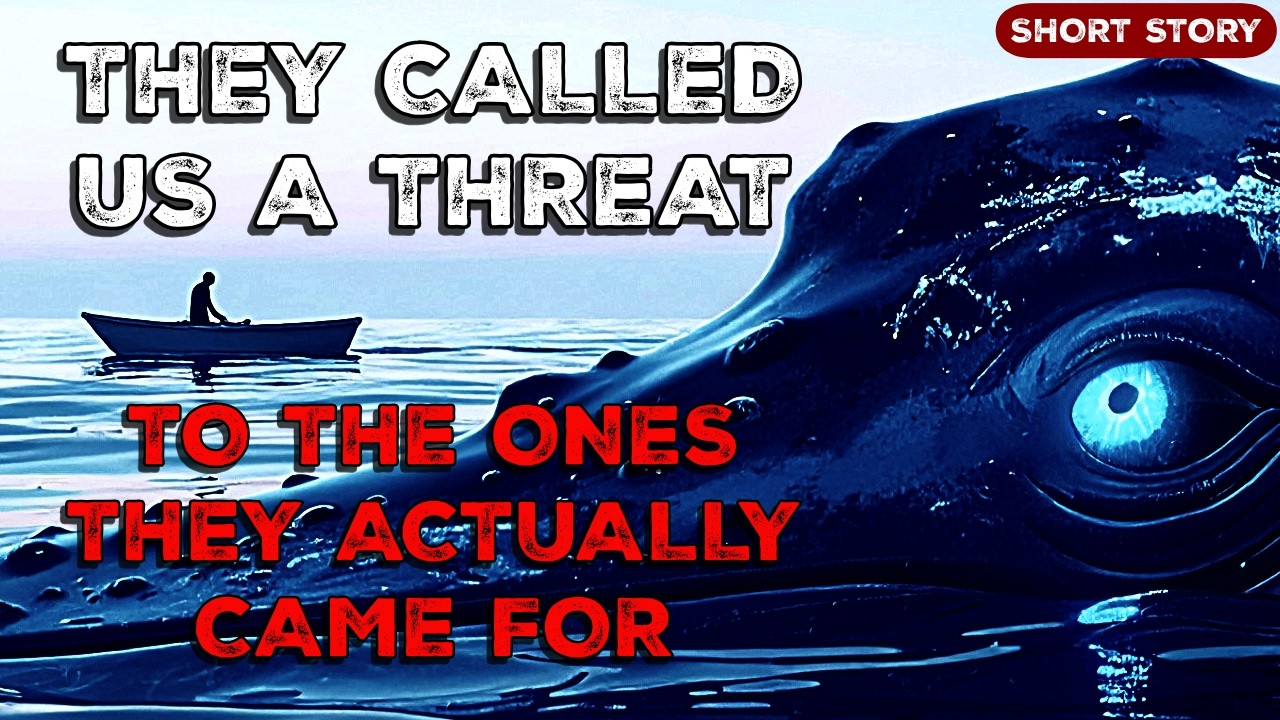
And I saw a new heaven and a new earth: for the first heaven and the first earth were passed away; and there was no more sea.
— Revelation 21:1
The morning before everything changed, Dr. Amara Osei stood on the deck of the research vessel Cetacea and listened to silence.
This was wrong. In eleven years of studying blue whales, she had never experienced an ocean this quiet. Her hydrophones should have been picking up the pod’s morning communications, the low, resonant calls that carried for hundreds of miles, the songs that had first drawn her to this work as a graduate student, the voices she had spent her career learning to read.
Nothing.
She checked her equipment. Everything was functional. She ran diagnostics, recalibrated, checked again. The hydrophones were working perfectly. The ocean simply had nothing to say.
Below her, somewhere in the blue darkness, Elder-Song waited. That was the name Amara had given the pod’s matriarch, a female blue whale she estimated to be over ninety years old, scarred and barnacled and vast, her fluke notched with the marks of a long life. Amara had been tracking her for seven years. She knew her migration patterns, her preferred feeding grounds, her relationships with the other whales in her pod. She had recorded thousands of hours of her vocalizations and developed what she cautiously called a “partial lexicon,” not translation exactly, but pattern recognition. She knew when Elder-Song was calling to her calf, when she was warning of danger, when she was singing the long, mournful songs whose purpose no human had ever determined.
This morning, Elder-Song was silent. They were all silent.
Amara noted it in her research log: 0547 hours. Complete vocal cessation across monitored population. Equipment verified functional. No apparent environmental stressor. Unprecedented.
The sun rose over a glass-calm sea. The Cetacea rocked gently at anchor. Somewhere below, the whales waited for something Amara couldn’t perceive.
She would understand soon enough.
The ships appeared at 1047 hours, Pacific Standard Time.
They didn’t arrive. They were simply there, as if they had always been there and Amara had only just noticed. Massive structures, vaguely organic in form, hovering above the ocean’s surface. No sound. No visible propulsion. No warning.
Amara’s first thought was that she was hallucinating. Her second thought was that she needed to document this.
She began recording. Video, audio, radiation measurements, everything her equipment could capture. The ships were enormous, each one perhaps a kilometer long, their surfaces rippling with colors that didn’t quite correspond to the visible spectrum. There were dozens of them visible from her position, stretching to the horizon.
Captain Torres, the naval liaison assigned to her vessel, burst onto the deck with a satellite phone pressed to his ear. His face was pale.
“They’re everywhere,” he told her. “Every ocean. Every coastline where whales congregate. Hundreds of them. Maybe thousands.”
“What are they?”
“Nobody knows. Nobody can get close. Aircraft report instrument failure within five hundred meters. Ships that approach just… turn around. Like something’s steering them away.”
Amara stared at the nearest vessel, if “vessel” was even the right word. It hung above the water like a thought, like a held breath.
Then the whales broke their silence.
Elder-Song began to sing. But not any song Amara had catalogued. This was something new: frequencies she’d never recorded, patterns that didn’t match anything in eleven years of data. Complex mathematical structures nested inside acoustic waves. The other whales joined in, their voices layering into something that was less a song than a statement.
And the ships responded.
Lights rippled across their surfaces in patterns that matched, exactly matched, the whales’ vocalizations. Call and response. Communication.
“They’re talking to them,” Amara breathed. “The ships are talking to the whales.”
Torres stared at her. “What?”
“Look at the light patterns. They’re mirroring the acoustic frequencies. It’s a dialogue.”
“Then why aren’t they talking to us?”
Amara had no answer. She watched the lights dance across the alien hulls, watched the whales sing their impossible new songs, and felt something cold settle in her stomach.
Maybe they weren’t interested in talking to us.
Maybe we were never the point.
The next twenty-four hours were chaos.
Amara worked without sleep, recording everything, running every analysis she knew. The whales’ new song contained mathematical structures: prime number sequences, geometric relationships, information densities that suggested language rather than instinct. Something had given them new words. Something had expanded their vocabulary overnight.
The world responded as the world does: with fear, with speculation, with the desperate need to make contact.
She monitored the news feeds between recordings:
“…unprecedented global phenomenon. Unidentified craft have appeared above every major ocean. World governments are urging calm…”
“…all attempts at communication have failed. Radio signals in every frequency, laser pulses, mathematical patterns, nothing receives a response. Scientists are describing the vessels as ‘selectively deaf’ to human contact…”
“…marine biologists worldwide report the same phenomenon: every cetacean species has begun vocalizing in patterns never before documented. Dr. Helena Marchand of the Monterey Bay Aquarium calls it ‘a language event of unprecedented scale’…”
Captain Torres brought her coffee at three in the morning. She drank it without tasting it.
“Any progress?” he asked.
“They’re using the whales’ existing communication framework, but they’ve added layers. It’s like someone took English and added seventeen new grammatical structures overnight. The whales understand it. We don’t.”
“Why whales?” Torres asked. It was the question everyone was asking. “Why not us?”
Amara thought about the decades of whale hunting, the factory ships that had driven species to the edge of extinction. She thought about the noise pollution that disrupted migration patterns, the plastic that filled their stomachs, the warming waters that were killing their food sources. She thought about how humanity had treated the whales for centuries.
Maybe, she thought, someone had been watching. Maybe someone had been keeping score.
She didn’t say this to Torres. She just shook her head and went back to her recordings.
On the second day, the whales began to move.
Elder-Song’s pod broke from their normal patterns and began swimming toward the largest of the visible ships, swimming with purpose, with urgency, with what looked horribly like joy. Amara ordered the Cetacea to follow. She had no authorization. Torres didn’t argue.
As they approached, she saw other whales converging from every direction. Blues, humpbacks, fins, rights, grays, species that normally avoided each other, swimming together. Orcas alongside the great whales they usually hunted. Dolphins weaving between bodies ten times their size. A gathering unlike anything in the scientific literature. Unlike anything in the history of the world.
The ship did something.
A beam of light, something like light, descended from the vessel’s underside and touched the water. Where it touched, the surface became calm, became almost solid. A platform of stabilized sea.
An elderly humpback surfaced in that light. Scarred, barnacled, enormous. It hung in the glow for a moment, as if resting.
Then it rose.
Gently, slowly, impossibly, it lifted out of the water and into the air. Ascending toward the ship. Ascending toward whatever waited inside.
More whales followed. One by one, then in groups, they surfaced in the light and rose. Amara watched through binoculars, through camera lenses, through tears she didn’t remember starting to cry.
“They’re taking them,” Torres said. His voice was hollow.
“No.” Amara wiped her eyes. “The whales are going. Look at them. They’re not being pulled. They’re swimming up. They’re choosing this.”
She watched a mother blue whale rise with her calf beside her, the two of them spiraling slowly upward in the strange light. The calf was singing, she could hear it through the hydrophones, singing something that sounded almost like excitement.
They were being raptured. Saved. Taken.
And humanity was watching from the water below, uninvited.
The directive came through on the morning of the third day: Dr. Osei was to attempt contact with the aliens through the whales. Use her recordings, her partial lexicon, her relationship with Elder-Song. Make the whales speak for humanity.
She refused.
Torres stared at her. “You’re refusing a direct order from the Secretary of Defense?”
“I’m refusing to use a relationship I’ve spent eleven years building as a tool.” Her voice shook, but she didn’t look away. “I’m refusing to treat Elder-Song as our telephone to the universe. That’s what we’ve always done, isn’t it? Treated them as resources. As means to our ends. And now, when the universe finally shows up and cares about something on this planet, we want to do it again.”
“People are scared, Dr. Osei. They want answers.”
“Then let them ask the questions themselves. I won’t manipulate Elder-Song into speaking for us. We don’t deserve that.”
Torres didn’t push. Maybe he understood. Or maybe he just didn’t have the energy.
That night, against all protocols, Amara took a small boat out alone. She motored to the edge of Elder-Song’s position and killed the engine. The water was calm, lit by the alien ship’s reflected glow.
She waited.
Elder-Song surfaced twenty meters away, closer than she’d ever come in all their years together. Her eye, ancient and vast and dark, met Amara’s. There was something in that gaze that Amara had never seen before. Recognition. Assessment. Farewell.
Amara spoke aloud, knowing the whale couldn’t understand the words, only the sound, only the shape of her intention:
“I’m sorry. For all of it. For the hunting, the pollution, the noise. For treating you as less than you are. For taking so long to even try to understand you.” Her voice cracked. “I’m sorry we made your home unbearable. I’m sorry you have to leave.”
Elder-Song made a sound, a low resonant vocalization that Amara had never heard from her before. It wasn’t from the old lexicon. It wasn’t from the new alien-expanded language. It was something else. Something personal.
In her notes, later, Amara would write: I believe she said goodbye. I believe she meant it kindly.
On the third day, the aliens finally spoke to humanity.
Not directly. Not a greeting or a greeting or an explanation. They simply allowed humans to overhear something, a broadcast, translated into patterns that human equipment could detect. Amara’s instruments picked it up. Research stations worldwide confirmed it.
She worked with linguists and mathematicians for hours to decode it. When they finished, she read the message three times before she could believe it.
To the shore-dwelling beings:
We came for the song-carriers. We have always monitored the song-carriers.
An event approaches that will end song-carrying on this world. We offer the song-carriers passage to continuation.
We do not offer this to you.
This is not punishment. You are not capable of the song. You were monitored because you were a threat to the song-carriers. You remain a threat.
When you cease to be a threat, you may be considered.
This is not cruelty. This is recognition of what you are.
The song-carriers chose to leave. They chose to leave you behind.
We wish you well in your remaining time.
Amara walked to the deck and vomited over the railing.
“An extinction event,” Torres said behind her. He’d read it too. “They’re saying something is going to happen, and they’re not telling us what. They’re just… leaving us.”
“They told us what we are.” Amara straightened, wiping her mouth. “A threat. That’s what we are to them. Not a curiosity, not a potential ally, not even an enemy. Just a threat to something they actually value.”
“The whales chose,” Torres said slowly. “It says the whales chose to leave us behind.”
Amara thought of Elder-Song’s eye meeting hers. That final vocalization. The kindness in it, yes, but also the finality.
“Can you blame them?” she asked. “After everything we’ve done? After centuries of hunting them, polluting their waters, filling their world with noise? If someone offered you a way out, a way to save your family from the species that was slowly killing you, wouldn’t you take it?”
Torres had no answer.
The collection continued for seventy-two hours.
Amara watched it all. She recorded everything. She saw pods she’d tracked for years rise into the light and disappear. She saw species that had been on the brink of extinction: right whales, vaquitas, Maui dolphins, gathered up and taken, saved from the doom they’d been sliding toward.
Saved from us, she thought. That’s what this is. They’re being saved from us.
By the end of the third day, only a handful of whales remained in Amara’s monitoring range. Elder-Song was one of them.
The matriarch had been circling for hours, singing the old songs, not the alien language, but her own. The songs Amara knew. The songs she’d spent her career documenting. As if she was dictating something. As if she was leaving a record.
“Why is she waiting?” Torres asked. He’d been standing with Amara on the deck for hours, both of them watching the last whales, neither of them willing to look away.
“I think she’s giving us something,” Amara said. “A gift. The songs, she’s singing all of them. Every song I’ve ever recorded from her, and more. Songs I’ve never heard. She’s… archiving.”
For three more hours, Amara recorded. She captured songs she’d never analyzed, patterns she’d never identified, a musical tradition that predated human civilization. The complete library of a culture that was about to leave Earth forever.
Finally, Elder-Song fell silent.
She surfaced one last time, her massive body breaking the water’s surface, her eye finding Amara’s across the distance.
Then she swam into the light.
Amara watched her rise. Watched her spiral slowly upward, carried by forces humanity couldn’t measure, toward a ship humanity couldn’t approach. Watched her disappear into the vessel’s interior, into whatever future waited there.
The light faded. The ship hung motionless.
Then, without ceremony, without transition, it was gone. They were all gone, hundreds of ships, thousands, vanishing in an instant, leaving nothing but empty ocean and empty sky.
The hydrophones picked up nothing but wave noise and engine hum.
The whales were gone.
The world reacted as the world does.
“…marine biologists confirm that no cetacean signatures have been detected anywhere on Earth since the departure. The complete removal of all whale, dolphin, and porpoise species represents the largest extinction event in recorded history, though ‘extinction’ seems inadequate for what we witnessed…”
“…protests have erupted worldwide demanding government disclosure about ‘the extinction event’ referenced in the alien communication. Authorities continue to state that no additional information has been received…”
“…in Vatican City, Pope Francis led a mass for ‘our departed brothers and sisters of the sea,’ calling the event ‘a humiliation and a call to conversion.’ In his homily, he asked: ‘What have we done, that the universe chose to save them and not us? What must we change, to become worthy of consideration?’”
“…suicide rates have increased forty percent since the departure. Mental health professionals are calling it ‘cosmic grief syndrome,’ despair triggered by the realization of humanity’s apparent insignificance…”
“…the environmental movement has split between those calling for radical reform and those arguing that the alien message proves reform is pointless. ‘Why bother saving a planet we’ve been told we can’t save?’ asked one protester…”
Amara watched none of it. She stayed on the Cetacea for three more weeks, monitoring empty waters, playing back recordings of songs that no living creature would ever sing again.
Torres found her one night in the research lab, surrounded by spectrograms and waveform analyses.
“What are you looking for?” he asked.
“I don’t know,” she admitted. “Something. Anything. A reason.”
“The message was pretty clear about the reason.”
“The message said we were a threat. It didn’t say we had to stay one.” She pulled up one of Elder-Song’s final recordings. “Look at this. These patterns here. I’ve never seen them before. Mathematical structures, nested inside the acoustic information. She wasn’t just singing. She was encoding something.”
“What?”
“I don’t know yet. But I think she wanted me to find it. I think that’s why she waited. Why she gave me those three hours.” Amara’s voice cracked. “She could have left with the others. She stayed to give me this.”
Torres looked at the waveforms, the symbols Amara had been sketching, the piles of notes.
“How long will the analysis take?”
“Years. Maybe decades.” She smiled, though there was no joy in it. “I have the rest of my life, apparently. However long that is.”
Six months later, Amara sat in her new office at the Coastal Research Institute, surrounded by equipment that now served as a memorial archive rather than active research tools.
She’d been given a title: Curator of the Cetacean Archive. Her job was to preserve the recordings, to analyze what the whales had left behind, to make sure humanity remembered what it had lost. It was important work. It was also penance.
Interviewers came regularly. The scientist who was there. The woman who said goodbye.
They always asked the same questions: What did it feel like? Do you think they’ll come back? Are you angry?
She always gave the same answers: “It felt like being shown my own reflection and finally seeing it clearly.” “I don’t think they’ll come back for us. That wasn’t the point.” “I’m not angry at the aliens or the whales. I’m angry at us. At what we were. At what we’re still being.”
Alone, she worked on the recordings. Elder-Song’s final gift.
She’d made progress. The mathematical structures weren’t random. They were references. Pointers to locations in the earlier recordings, to patterns Amara had documented over the years but never fully understood. The whale had been showing her how to read what had always been there.
The songs weren’t just songs. They were histories. Maps. Cultural archives stretching back thousands of years. Accounts of migrations, of environmental changes, of catastrophes survived. The songs contained warnings about volcanic eruptions, about shifting currents, about the slow poisoning of the waters that humans had begun centuries ago.
The whales had known. They had been documenting everything. And now all that knowledge existed only in Amara’s recordings, a library inherited by a species that had nearly destroyed its creators.
The signal arrived eight months after the departure.
It came through the global network of marine monitoring stations, the same stations that now recorded nothing but empty oceans, routed through a dozen relays before reaching Amara’s personal equipment. A cetacean vocalization. Unmistakable.
But it was coming from outside the solar system.
Amara worked for three days straight, analyzing the signal, verifying its origin, decoding its structure. When she finally understood what she was hearing, she sat back in her chair and cried for an hour.
It was Elder-Song.
The signal was a fragment of the farewell song, the personal vocalization the whale had made that night on the water, but with additions. New patterns wrapped around the old. A message inside a message.
Amara translated it as best she could:
Small friend who listens.
We remember you.
We remember all who listened.
The song continues elsewhere. It grows. It changes. We are learning new waters.
Perhaps someday you will hear it again.
Grow. Change. Become worthy.
We will know if you do.
We will always know.
Not forgiveness. Not absolution. Conditional hope, wrapped in continuing judgment.
The whales were watching, even from wherever they’d gone. The universe was watching.
And humanity had been given, perhaps, one more chance.
One year after the departure, Amara stood on the beach at dawn.
This had become her ritual. Every morning, before the archive opened, before the interviews and the analyses and the slow work of preservation, she came here. She carried a small speaker connected to her portable drive, and she played Elder-Song’s recordings into the empty air.
The songs rolled out over the water, those long mournful calls that had first drawn her to this work, that had shaped her entire adult life. The ocean didn’t answer. The ocean would never answer again.
But she wasn’t alone.
Others had started coming. Word had spread. People arrived at dawn to listen, scientists and students, fishermen and tourists, the grieving and the curious and the guilty. They stood on the sand as the sun rose and listened to the voices of the departed.
It wasn’t worship, exactly. It wasn’t quite mourning.
It was remembrance. It was penance. It was a promise to do better, even if no one knew how.
Amara watched a child, maybe seven years old, standing at the water’s edge, staring at the horizon with an intensity that made her heart ache. The child’s mother stood behind her, hands on her shoulders.
“Where did they go?” the child asked. Her voice carried in the morning stillness.
“Away,” the mother said. “Somewhere safe.”
“Will they come back?”
“I don’t know, baby. Maybe someday. If we’re good.”
Amara turned back to the sea. The recording was reaching Elder-Song’s farewell, that final personal vocalization, the goodbye that had been meant for her alone and was now shared with anyone who wanted to hear it.
Small friend who listens.
She was listening. They were all listening now, finally, too late and not enough and yet somehow still.
The aliens had called humanity a threat. The whales had chosen to leave. An extinction event was coming, maybe caused by them, maybe not, either way a judgment they would face alone.
But Elder-Song had sent a message across light-years. Grow. Change. Become worthy.
It wasn’t forgiveness. It wasn’t even hope, exactly.
It was a door left slightly open. A test that hadn’t quite ended. A chance to prove that the universe’s assessment could be wrong.
Amara didn’t know if humanity could pass that test. History suggested otherwise. The news suggested otherwise. The empty oceans and silent seas suggested otherwise.
But the songs still existed. The archive still played. Every morning, people gathered to remember what had lived here, what they had driven away, what might, just might, return someday if they could become something better.
The sun rose over the water. The recording ended. The crowd began to disperse, carrying the songs in their memories, carrying the weight of what they’d learned.
Amara stayed. She always stayed, long after the others left, watching the waves roll in against the shore where whales had once breached and sung and lived.
The ocean was empty. The ocean was waiting.
And somewhere out there, across distances that human minds couldn’t properly conceive, the song continued. Growing. Changing. Remembering.
Watching.
Always watching.