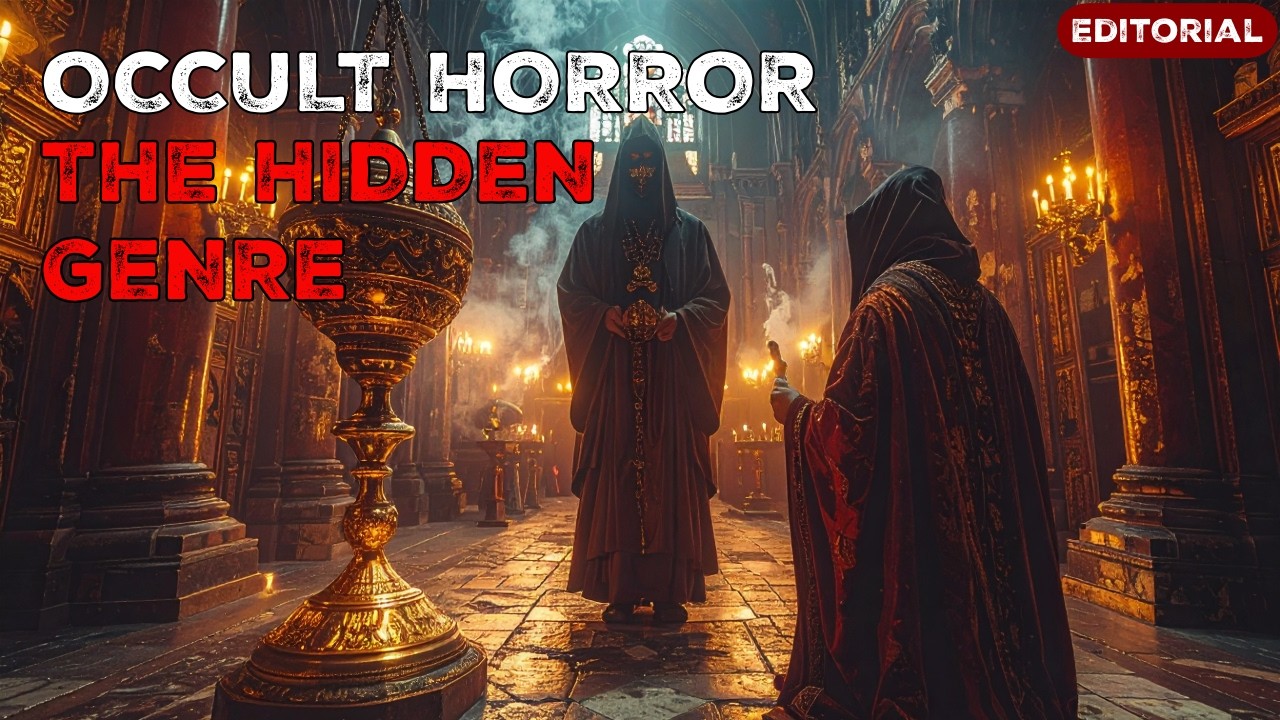
The word occult means hidden.
That single definition of occult contains everything you need to understand the genre it names. Occult horror isn’t primarily about witches, demons, cults, or grimoires, though all of those appear in it. It’s about the terror of what has been concealed from ordinary human sight, and what happens to the person who goes looking for it anyway.
Most horror confronts us with something, while occult horror confronts us with something we were never supposed to find. That distinction matters, making it the load-bearing wall of the entire subgenre.
Defining Occult Horror
Occult horror is a genre that explores supernatural beliefs and practices that fall outside of mainstream religion and science, think mysticism, spirituality, astrology, magic, and psychic phenomena. In the horror context, these traditions are twisted or exaggerated into black magic, sinister cults, evil supernatural forces, and the pursuit of secret knowledge or power.
But that definition, while accurate, undersells the genre’s true engine. When we speak of “the occult,” we’re talking about esoteric supernatural beliefs and practices that generally fall outside the scope of organized religion and science. It’s the domain of mystics, wizards, gurus, magicians, big on spells and sacred books. It’s basically High Religion for the underworld, where you’ll find groups such as the Hermetic Order of the Golden Dawn, and beliefs such as Spiritualism, Theosophy, and the New Age. The horror enters when those systems of hidden knowledge stop being theoretical, when someone actually opens the door.
Occult horror as a literary category sits at the intersection of three older traditions, which are the gothic (atmosphere, decay, inherited dread), weird fiction (cosmic indifference, the inhuman sublime), and theological horror (the spiritual order of the universe, transgression, consequence). Where those three traditions converge, you get the occult horror short story at its most powerful, a form that uses the machinery of the forbidden to ask questions about reality that polite fiction refuses to touch.
The Word Itself: Why “Hidden” Is the Point
The Latin origin of the word occult is occultus, meaning concealed, secret, or hidden from view and was originally a neutral term. Medieval and Renaissance scholars used it to describe knowledge that simply hadn’t been made publicly available, such as hermetic philosophy, alchemy, kabbalah, and astrology. These were not fringe superstitions, they were the serious intellectual pursuits of educated men who believed the universe had a deeper structure than the visible one, and that this structure could be read, mapped, and in some cases, manipulated.
The Church’s hostility to occult practice, and the branding of occultists as worshippers of Satan, usurpers of God’s all-encompassing control over mankind, and virgin-sacrificing heretics, created the template that occult horror fiction would eventually inherit. The occultist became the transgressor as the one who reached past the sanctioned boundary.
This is why occult horror’s moral architecture feels different from standard supernatural horror. In a classic ghost story, the horror comes to you. In an occult horror story, you go to the horror. You chose, sought, and knocked on that door. That active seeking is the genre’s defining moral feature, and its most potent source of dread.
How Occult Horror Differs From Supernatural Horror
This is the question most genre guides skip. They treat “occult horror” and “supernatural horror” as rough synonyms, varying only in furniture (grimoires instead of haunted houses, rituals instead of apparitions). That’s wrong.
In pure supernatural horror, the protagonist is initially thrust into the hidden world unawares, or has the hidden world surround them unbidden. In occult horror, a conscious decision is made by the protagonist to enter the hidden world. This leads to a crucial element of occult horror, which is the moral choice.
That distinction reshapes the entire emotional logic of the story. Supernatural horror produces sympathy, the characters are victims. Occult horror produces something more uncomfortable, complicity. The reader watches a character pursue forbidden knowledge, and some part of the reader wants them to succeed. We are implicated in the seeking and we wanted to know too.
In the same way that supernatural horror appeals to that part of us that cannot, or will not, accept death, occult horror speaks directly to the part that cannot comprehend how as great a being as man simply cannot control his immediate environment, let alone his destiny. That’s the wound occult horror presses on. Not the fear of death. The rage at limitation.
The Core Narrative Devices Of The Occult Horror Short Story
Short fiction is particularly suited to occult horror because the genre thrives on compression and revelation. The short story can deliver a single forbidden threshold and its immediate aftermath without the sprawl of a novel. The best occult horror short stories function like parables, they do not need to explain everything. The horror lives in what remains unsaid after the final line.
The genre’s recurring elements include:
The Grimoire or Sacred Text. There will typically be an occult book of some description, a grimoire, the Necronomicon, as well as rituals, spells, and paraphernalia, such as a ouija board or a puzzle box. The text-as-door is one of horror’s oldest images, but occult horror makes it literal. To read is to begin. To understand is to be changed.
The Summoning and Its Rules. There are rules that must be followed, but that also bring drama when broken. The occult horror story is structurally obsessed with rules because rules imply a cosmos that has order, and the horror of the genre often lies in discovering that the order is not what you assumed. The rules were written by something with its own agenda.
The Seeker. Someone driven to uncover hidden or forbidden knowledge, often at great personal cost. This character type is the genre’s protagonist by default, not a victim stumbling into darkness, but someone who went looking for it with purpose. Their motivation tells us everything, including grief, ambition, intellectual hunger, desperation, and pride. The Seeker is Faustian at the root.
The Practitioner and the Antagonist. Characters engage directly with occult rituals and magic, often to either summon or banish dark forces. Antagonists in occult horror come in many forms, from human cult leaders to demonic entities. The most unsettling version of the antagonist is neither, it is the system itself. The ritual that works exactly as advertised.
The Moral Ambiguity. Essentially, the stories are good vs. evil, but we’re never sure which side is actually the good. This is what separates well-executed occult horror from simple monster fiction. The darkness has a logic, forbidden knowledge is often true, and the reader ends the story not knowing whether the protagonist’s transgression was a sin or a revelation.
The Lineage: From Faust To Folk Horror
Occult horror has the deepest roots in the Western literary tradition of any horror subgenre. The story of Faust, in which a man trades his immortal soul to Mephistopheles in exchange for magical powers, having concluded that the dark arts were the only way to fully realize his desire for wisdom, is the archetypal core narrative that informs the genre across centuries.
H.P. Lovecraft’s use of occult narrative devices typically acts as a gateway to his science-fiction-esque worlds of gods and monsters. More substantive is his deduction that uncovering the vast, cosmic truths of the universe is likely to appear horrific to the average human and leave them mentally unstable. In Lovecraft, the occult book doesn’t summon a demon, it proves, mathematically, that humanity is irrelevant. That’s a specifically modern form of occult horror, one where the hidden knowledge is worse than any monster it might contain.
Moving outward from the Faustian center, the genre branches into subforms that have developed their own conventions.
Gothic occult horror works through atmosphere and inheritance, curses passed down bloodlines, houses that remember rituals performed in them, and families paying for bargains their ancestors made. The hidden knowledge is geological, layered into stone and soil.
Folk horror, the current rising star of the dark pantheon, roots occult practice in community rather than individual transgression. The horror is not that one person sought forbidden knowledge; it is that an entire village has always known it. The outsider walks into a world where the ritual is simply life, and what is hidden is hidden only from them.
Paranormal horror extends occult horror into the present tense, haunting, psychic phenomena, possession, where the hidden world is not accessed through deliberate practice but bleeds through the walls of the ordinary world unbidden.
Body horror becomes occult horror when the transformation of the body is the consequence of transgression, when what was done in ritual space writes itself onto flesh. The body becomes the text and the evidence.
All of these are branches of the same root system. Occult horror is the parent genre, and the others inherit its logic.
What Theological Horror Adds to the Conversation
Most genre guides treat occult horror as secular, a flavored brand of supernatural fiction with Latin incantations and ominous props. That reading misses the genre’s deepest layer.
Where religious and possession horror deals with crises of faith, occult horror explores the mystic, the pagan, and the satanic. It finds its roots in a time when the Church said the priest was the only one who could talk to higher powers. The occultist came along and insisted he could communicate directly with the “unseen forces.” This is not merely historical context. It is the genre’s live theological nerve.
Occult horror at its most serious is not about whether magic works, it’s about the structure of the universe, the nature of what is hidden, and the cost of unauthorized access. It presupposes that the cosmos has an order, and that this order has been concealed from ordinary human sight for reasons that may be protective, punitive, or simply indifferent to human welfare. The occultist is not wrong that something is hidden. The horror is in discovering what is hidden, and why.
This is precisely where theological fiction and occult horror short stories produce their most interesting work together. The horror is not that God doesn’t exist. The horror is that the universe has a structure, and you have just located yourself outside it.
At Apokalypsis, this is the territory we treat with complete seriousness. We are not interested in occult horror as aesthetic cosplay, ominous symbols, brooding atmosphere, and conveniently evil cults. We are interested in occult horror that earns its dread through genuine theological weight. Fiction where the forbidden knowledge is forbidden for a reason that the story forces you to reckon with.
What Makes an Occult Horror Short Story Work
The short form imposes discipline on a genre that can otherwise sprawl into worldbuilding. A successful occult horror short story needs.
A single, clearly defined threshold. One door that should not be opened. One text that should not be read. One name that should not be spoken. The compression of short fiction means the story should not traffic in multiple transgressions, instead, it focuses on the forbidden.
A seeker with a comprehensible motivation. Grief, ambition, love, survival. We don’t need to approve of what the character does. We need to understand why a human being would do it. That understanding is what makes the horror stick, it indicts us.
Rules with teeth. The occult system in the story should have internal logic. If the rules can be violated without consequence, there is no tension. If the rules exist only to be violated, they are not rules, they are plot devices. The best occult horror establishes a system and then shows you exactly what it costs to interact with it.
An ending that does not explain everything. The hidden world should remain, in some dimension, hidden. The reader should close the story knowing more than they did at the opening but still standing outside something that will not fully resolve. That unresolved remainder is where the horror lives after the story ends.
Reading Occult Horror at Apokalypsis
The occult horror short stories published here are written in full awareness of this tradition, and in deliberate conversation with its theological depth.
“The Ritual Chamber“ is a story about a man completing his initiation into the highest order of a secret society, who reads the truth of what he is about to become stitched into the velvet walls of the corridor, and walks through the door anyway.
“Stone Made of Ghost“ is a story about forbidden geography, the archaeology of impossible things, and a professor who has spent a career helping serious men chase serious money, until a young man arrives with a crystal that bends physics and a map to a city where light cannot exist.
Both operate in the territory defined above, which is conscious transgression, moral implication, a cosmos with structure, and horror that does not resolve into comfort. If you are new to occult horror fiction, these are the right doors to open first.
If you already know the genre, if you have followed it from Faust through Lovecraft through folk horror’s resurgence, you know what we are reaching for. The story that knows what it believes about the nature of what is hidden, where the dread is earned.
That is what we publish, and this is what we are building.